Commercial vs Residential Property in Mumbai: Differences, Returns, and What to Choose
June 25, 2026 in Property Guide
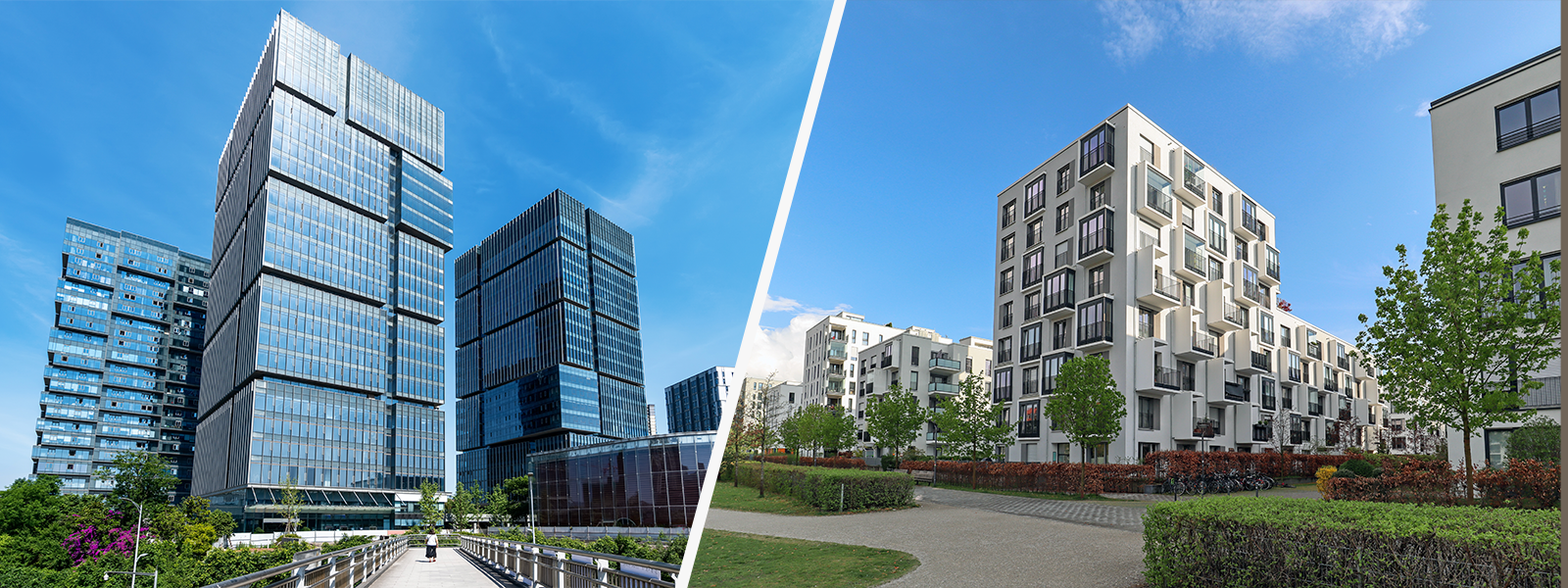
Mumbai, the financial epicentre of India, boasts one of the most dynamic, high-stakes real estate markets in the world. For any investor looking to deploy capital here, the ultimate crossroads is deciding between commercial vs residential assets. If you are entering the market for the first time, your selection will fundamentally shape your upfront capital needs, your day-to-day management routines, and your final returns.
Neither sector is universally superior; rather, they align with entirely different financial capacities, time horizons, and risk tolerances. To navigate this successfully, one must dissect the structural differences between these two traditional powerhouses of Mumbai real estate.
This blog explains the key differences between commercial and residential property investments in Mumbai, helping you evaluate which option aligns best with your financial goals.
Defining the Asset Classes in Mumbai
Before examining yields and entry points, it is vital to outline how these properties function in a hyper-dense metropolitan area like Mumbai.
-
Residential Property
Residential real estate covers spaces designated strictly for human habitation. In Mumbai, this predominantly manifests as high-rise apartments, luxury condominiums, and redeveloped gated communities. These properties serve a dual role: they can be owner-occupied by families or leased out to tenants for personal living.
The underlying valuation of a home is strongly tied to emotional and lifestyle factors, including neighbourhood status, proximity to top-tier schools, transport links like the coastal road or local rail, and local housing demand.
-
Commercial Property
Commercial property refers to real estate designed specifically for business operations and income generation. In Mumbai's context, this includes Grade-A corporate office towers, co-working facilities, retail showrooms, banks, warehouses, and industrial spaces.
Unlike homes, commercial assets are valued strictly on their income-producing capabilities. Investors evaluate them via macro-economic factors, net operating income (NOI), tenant creditworthiness, and capitalisation rates.
Differences Between Residential and Commercial Real Estate
To truly grasp the difference between commercial and residential property, one must look beyond the physical structures and analyse how they perform across various legal, operational, and financial dimensions.
| Metric | Residential Real Estate | Commercial Real Estate |
|---|---|---|
| Lease Duration | Usually 11 to 24 months | 3 to 10 years (with lock-ins) |
| Initial Down Payment | Lower (typically 15% – 25%) | Higher (typically 20% – 40%) |
| Interest Rates | More competitive (home loan rates) | Higher (commercial business terms) |
| Tenant Profiles | Individuals and families | Corporations, retail brands, LLCs |
| Vacancy Duration | Shorter (usually weeks to months) | Longer (can sit empty for up to a year) |
| Management Effort | Simpler, though it requires personal interaction | Complex, often requiring professional agencies |
Deep Dive into Returns: Yields and Capital Appreciation
When comparing residential and commercial investments in Mumbai, the way your investment generates income can differ considerably.
-
Rental Income Dynamics
Commercial real estate is famously known for delivering superior rental yields. In premium commercial micro-markets, annual yields of 7% to 10% are standard. This is because corporate entities are willing to pay premium per-square-foot rates for strategically positioned offices that drive business efficiency. Furthermore, commercial leases span 3 to 10 years and contain predefined rental escalations, offering predictable, long-term income stability.
On the flip side, Mumbai's residential market is notorious for modest rental yields, hovering around 2% to 5%. Because residential leases are shorter, often structured as 11-month leave-and-license agreements, investors face more frequent tenant turnover and recurring marketing costs.
-
Capital Appreciation and Micro-market Performance
While commercial properties lead in rental yield, residential properties often offer highly reliable capital appreciation in a land-starved city like Mumbai. If you buy a flat for sale in Bandra, for instance, you are tapping into one of the most culturally desirable, supply-constrained residential markets in India.
Similarly, established locations such as Byculla and emerging residential hubs like Thane continue to attract buyers due to improving infrastructure, connectivity and sustained housing demand. The limited availability of land across these micro-markets supports long-term capital growth. Conversely, if you shift your focus slightly eastward to the corporate epicentre, finding a premium office or flat for sale in BKC changes the investment math.
For upscale end-users and investors looking at premium configurations, the market for luxury 2 and 3BHK flats in Mumbai acts as a baseline indicator of residential health, balancing high tenant demand with resilient valuations across major urban nodes.
Financing, Capital, and Operational Demands
The entry barriers for residential and commercial real estate present entirely different hurdles for individual investors.
-
Financing Restrictions
Securing a mortgage for a home is a highly streamlined process. Lenders look primarily at personal credit history, salary stability, and debt-to-income ratios. Down payments are low, and buyers enjoy competitive interest rates along with attractive income tax deductions on principal and interest repayments under Indian tax laws.
Commercial financing, however, involves a far stricter approval protocol. Lenders demand higher down payments (frequently 30% to 40% of the total asset cost) and charge interest rates that are typically 1% to 3% higher than residential home loans. The approval process hinges on the property's Debt Service Coverage Ratio (DSCR) and the credit score of your business tenants rather than your personal financial standing alone.
-
Management Complexity and Risks
Operating a commercial asset requires a sophisticated baseline of market knowledge. Commercial landlords deal with complex corporate lease structures, strict local zoning laws, and Goods and Services Tax (GST) compliance. Furthermore, if a corporate tenant vacates, finding a replacement can take six months to a year, forcing the owner to carry property taxes and upkeep costs without any inbound cash flow.
Managing a home is far more intuitive. Most landlords can handle routine maintenance and tenant communications without professional property management firms. Residential demand also remains highly resilient during macro-economic contractions; while companies might downsize their office spaces during a recession, individuals always require a place to live.
The Verdict: What Should You Choose?
Your ultimate decision between residential and commercial property in Mumbai must match your personal financial ecosystem.
Choose Residential Property If:
- You have a moderate capital base and wish to utilise highly accessible, lower-interest bank loans.
- Your priority is long-term capital appreciation and owning a tangible, liquid asset in a premium neighbourhood.
- You prefer low-stress property management and intuitive, easily understood market dynamics.
Choose Commercial Property If:
- You possess substantial initial capital and are prepared for higher upfront down payments.
- Your primary objective is maximising monthly cash flow via superior 7% to 10% rental yields.
- You prefer structured, professional relationships with corporate entities rather than dealing with individual families or tenants.
By evaluating your capital threshold, your capacity for handling vacancy risk, and your desired yields, you can confidently choose the ideal asset type to unlock Mumbai's vast real estate wealth.
Making the Right Investment Choice in Mumbai
Choosing between commercial and residential real estate in Mumbai ultimately depends on your financial goals, investment horizon and risk appetite. Residential properties often attract investors seeking long-term capital appreciation and relatively straightforward management, while commercial assets may appeal to those prioritising higher rental yields and stable income streams.
At Adani Realty, we provide both residential and commercial developments across Mumbai's key micro-markets, enabling investors to explore opportunities that align with their unique objectives. By carefully evaluating your priorities and selecting the right asset type, you can build a property portfolio designed for long-term growth and value creation.


Looking for dream spaces, not sure where to start?
Leave us a query and our representative will get back to you.
Disclaimer
The Adani Realty expressly disclaims all liability in respect to actions taken or not taken based on any or all the contents of this Blog. The content of this blog is collation of data from various sources and is provided only for information purpose only and Adani Realty does not canvass the particulars, information, brand or any other materials mentioned in the blogs nor does it obtain any monetary benefit from the same.The Adani Realty shall in no circumstance be held liable for any expense, loss or damage including, without limitation, direct, indirect or consequential loss or damage, or any other expense, loss or damage whatsoever arising from the use of data, information, interpretation, judgement or opinion arising out of or in connection with the use of this Blog. Reader is advised to read and apply his/ her intellect and discretion in this regards.